Monday, September 27, 2010


Total Contentz is pleased to announce that we have now moved into a new office in beautiful Simi Valley, California.

Contents Division Development and Specialty Contents Processing and Inventory Workshops will be held in the neighboring recently built UltraCare Contents and Electronics Restoration Facility. The building is large enough to accommodate up to 50 participants and features wireless internet. Contents Processing Workshops and training events scheduled throughout the year. For a complete list of scheduled training, please visit www.totalcontentz.com.

The City of Simi Valley, with an estimated population of 126, is the third largest of Ventura County's ten cities. It is ranked #17 in the top 25 safest cities in the United States. It is located in Southeast Ventura County, adjacent to the northwestern perimeter of the San Fernando Valley, approximately 37 miles northwest of downtown Los Angeles, 30 miles northeast of beautiful Malibu Beach and 35 miles from Burbank Airport.

Total Contentz is a training and membership organization that provides a Total Systemz Approach to contents processing. It’s educational programs cover pack outs, photo inventory systems, contents division management, estimating, job planning, warehousing management and human resources with more to be announced soon.

For more information on Total Contentz, call 1.888-522-5900 or visit www.totalcontentz.com.

Total Contentz 845 E. Easy Street, Suite 102, Simi Valley, CA 93065

Organizing the Day

Published on September 23rd, 2010

by Steve Cohen

Organizing the day. Everyone eventually has their day fall into a routine. There are a certain number of tasks that must be done to conduct a day of business and balance life on the side. Sometimes this routine becomes your life and your goals fade with the demands of getting into the office, handling daily problems, and dealing with everything else. For people building a business or recasting their lives, routine can overwhelm you and eventually retard your efforts to change.

This happens because each day is just allowed to evolve against the forces that surround us. With no plan, the forces guide the day. This is not some ethereal concept from Star Wars; there are events, people, and concerns that can force a day in a direction that has nothing to do with intended goals and objectives. Often the “forces” are more interesting, or enough of a diversion to offer a departure from that routine that is already feeling too much to handle.

Each day should start with a simple list of intentions. Write them down before you end your day and follow them each morning. The list should include:

Personal Intention:

Usually one self-motivating goal that stretches you as a person. You may choose to be more silent; pause before you speak; have a day without a negative thought; be a champion of praise. Sometimes you may repeat an intention you want to utilize again.

Business Intention of the Day:

What is it precisely you want to achieve today? Make it a single thought and make it achievable. For example: return all phone calls at the same time each day; hire a new employee, publish a new ad; join the Chamber of Commerce. This is easy to dodge. But if you force yourself to a goal a day, each month you will observe measurable growth in your business.

Schedule Intention:

How will you structure the day to be most effective and provide the balance you need to feel fulfilled? Often the same structure is too restrictive and destroys creativity. Alter the mix of business, exercise, family, and fun each day in your planner. A day should have periods of intense, focused activity, and periods of release. This compression and relaxation will eventually become a natural flow for you and you will seek it out, as your planning adapts to your life cycle.

Long Term Intention:

Take 10% of your work time and devote it to master planning, long-term goals and super thinking. Super thinking is about letting go and directing your thoughts to the horizon. A few minutes each day to think outside your routine can rocket your business to new heights that come from freethinking. If you are selling two thousand units a month, how can you get to ten, twenty? Super thinking, even 10% of your day can bring enormous dividends, since most businesses never plan big thinking.

Having a day planned and based upon these intentions requires thought and observation of how you are doing and feeling as you conduct your business and your life. And it can create some dissonance because it demands introspection. But, without organization, you will find yourself in a rut, and worse, standing still. There is no reason to be adrift directed only by the forces around you that may take you far from your goals. Plan what you can, control that schedule, and execute what you plan each day.

The simple act of organizing your day will give you a special power that will help you succeed.

Friday, September 24, 2010

Reproduction Postcards: How to Spot the Copies from the Real McCoy

by Bonnie Wilpon (09/20/10).

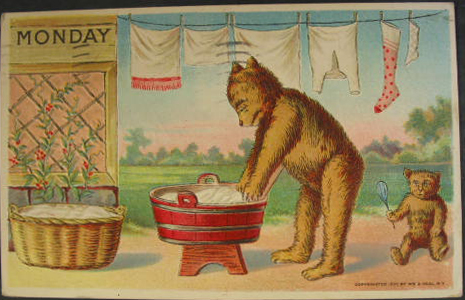
This vintage card shows the publisher’s copyright at lower right.

Postcards, like many other antiques, can be reproduced, and some repros are very hard to spot. Since one of the primary factors in a postcard’s value is its age, repros have little monetary value. In spite of that, they may be desired by some collectors due to their subject matter. Like fine art, some cards are so costly that collectors can’t afford to buy originals, and may settle for repros just to have the images in their collections.

For example, vintage postcards of Kewpie dolls generally start in the $50 range. but cute repros can be had for under $2. Sets, such as Days of the Week, continue to be popular with collectors and with folks who use them for correspondence, and repros are popular.

So what are the telltale signs of reproductions? Often, pre-1920 greetings, now out of copyright, are reproduced by reputable printing and stationery firms.

For example, take the Bear Family Days of the Week cards, which originally published by Heal’s, circa 1908. The Monday card, showing laundry day, is an original. You can see the publisher’s mark in the lower right corner.

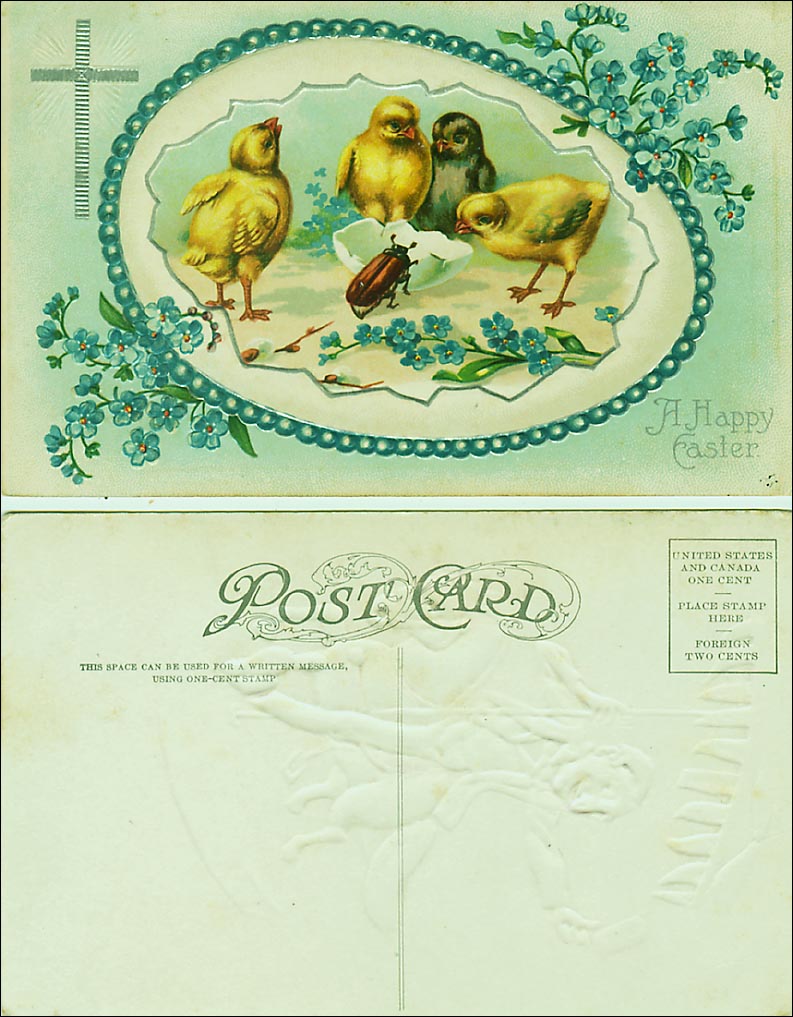
In an original postcard, the front and back sides match in terms of era.

Like the Easter card shown, both the front and the back sides show signs of pre-1920 markings. The back side of this Easter card shows embossing, as well as a pre-20 stamp box and vintage publisher’s logo.

On the other hand, the back of the Tuesday “Ironing Day” card, is a clear reproduction from Merrimack. This reputable publisher notes “Replica of the Antique Original” on the top of the address side, and shows its name and zip code (a clear indication of post-1963 publication) at the bottom.

This repro is clearly labeled as such by the publisher.

What if this repro was from a rogue source and didn’t include those clear signs? One clue is the brightness of the green printing, which we don’t see on pre-’20s cards, since the colors used on the back side were much more muted back then. And, look at the stamp box: pre-’20s cards never had the single word “stamp.”

This card shows a real photo back.

But the front is a printed reproduction of Thunderjet.

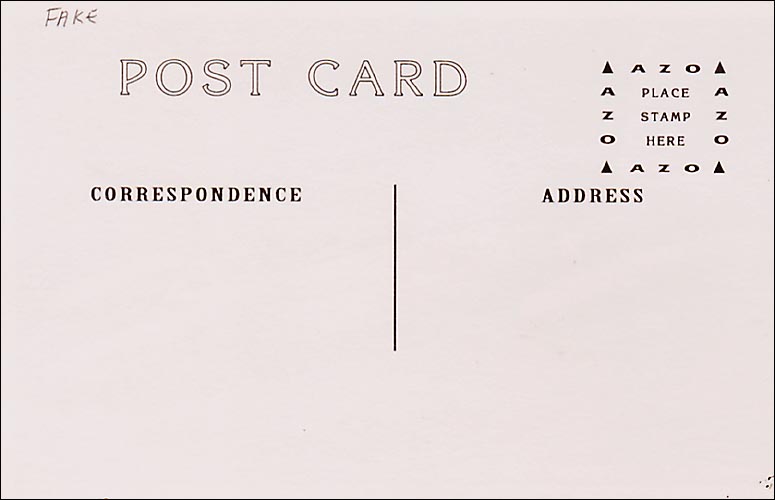
The black-and-white Republic F-84E Air Force Thunderjet is a reproduction as well. The postcard is clearly a printed card, which is evident from its finish. Under magnification, you can see the dot pattern that characterizes Moderns. Yet, the back side carries an AZO Points Up stamp box, indicating a Real Photo card published between 1904 and 1918.

The popular Linen-era cards are being reproduced as well, and even long-time collectors have been taken in, recognizing some of their “great buys” as repros only after examining their purchases carefully at home.

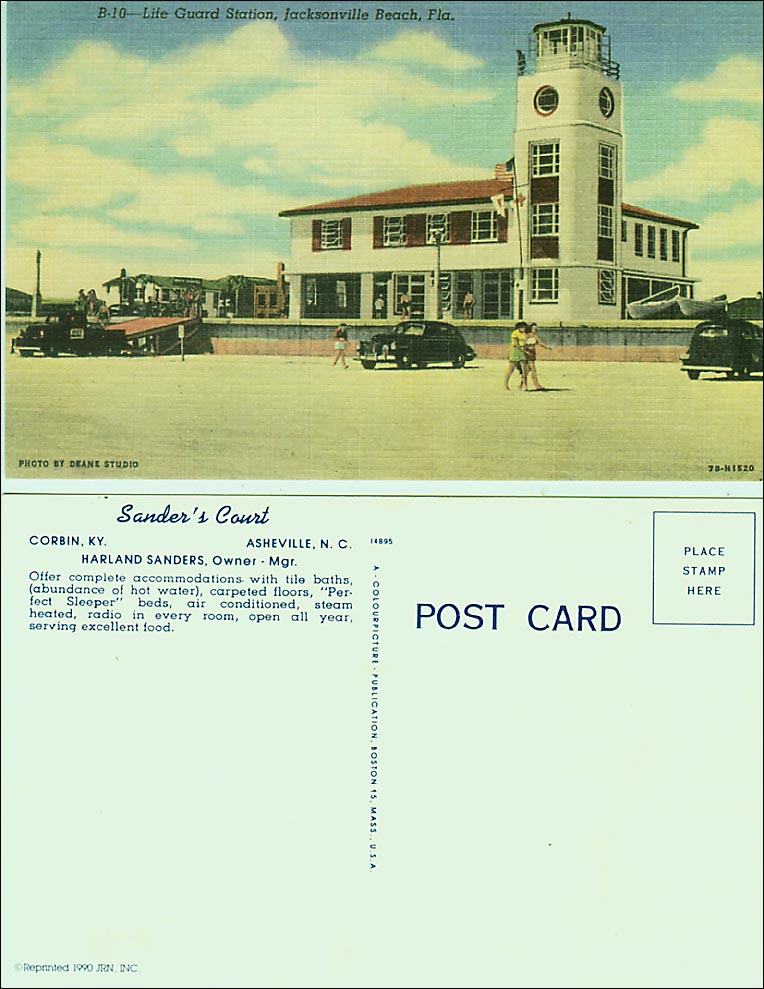
Below, we see a composite of two linen cards that have been reproduced. The top card, the Life Guard Station on Jacksonville Beach, FL, shows very muted coloration. Most Linens are bright—even garish—but not this one, which was the first clue. Additionally, this card is lighter in weight than the typical Linen. It just doesn’t have the “heft” that it should.

Linen cards aren’t immune from reproduction. Check the backs carefully, note the “heft,” and examine the coloration of the image for fading.

The back side shown here is from a postcard of Sanders Court, the 1930s motel venture by “Colonel” Harland Sanders of Kentucky Fried Chicken fame. The original Court/Café in Corbin, Ky. was demolished in the late 1960s, making this a collectible subject.

Tougher to spot as a repro, the back side looks vintage, including the original Colourpicture publisher’s mark and stock number. But closer examination shows, in 5-point type at the lower left, a note saying “Reprinted 1990.” Like the Jacksonville Beach card, the color saturation of the image and the “heft” were clues.

This is a real Linen card. It “feels” like it’s genuine.

Other reproductions are almost impossible to illustrate, because they’re so well done. One unscrupulous trick is to literally glue a reproduced image to another postcard – one that truly is vintage, so the back side appears to give it the authenticity of a pre-20 or pre-1908 card. In this way, a forger can turn a worthless common vintage card into a sought-after busy street scene.

It’s easier to unwittingly buy a repro through the Internet because you can’t actually examine and touch the postcard. But even at shows, repros can end up in your bag if you’re going through cards quickly—especially when they’re encased in plastic sleeves, which dull the image slightly and disguise the postcard’s weight.

Reputable dealers will mark cards in their stock as reproduction if they’re aware that they are repros. Sometimes, in their hurry to mark and sleeve a large collection of cards they’ve purchased, they’ll miss one, though. I’ve seen dealers at shows get the opinions of other dealers as to whether a skillful repro is an original or not when they’re in doubt themselves.

The moral of the story? Examine postcards very carefully, front and back. Read all the fine print. Pay attention to the “feel” of the card and the appropriateness of its colors to the era. Make sure the age signs of both sides of the card match each other. If you’re in doubt, ask the dealer to help you examine the postcard more closely.

Bonnie Wilpon, the author of “Postcard History of Sarasota and Bradenton, FL,” and “Postcard History of Hollywood, FL.” (published by Arcadia Books), is a Worthologist who specializes in postcards.

————————————

WorthPoint—Discover Your Hidden Wealth

Share

Share

Antique & Collectible Extravaganza

Event Detail

Antique & Collectible Extravaganza
Spence's Bazaar
Dover, Delaware (DE) 19901 United States

On Sunday, Oct. 3, 2010, the fourth Delaware Antique & Collectible Extravaganza—Del Mar Va's largest free outdoor antique and collectible show—will be held at Spence's Bazaar, 550 S. New Street, Dover, Delaware, 19901.

Antique and Collectible dealers from up and down the east coast will be offering a wide variety of merchandise sure to please enthusiasts and shoppers with varied tastes. Vintage furnishings, artifacts, jewelry, porcelain, ephemera, glassware, advertising, dolls, furniture, trains, pottery, music, sports, auto, memorabilia, collectibles, toys and much more will be featured.

Admission to the show is free. Gates open at 10 a.m. show runs till 4 p.m. Food will be available and free parking, Vendors space is still available call and leave message. For more information on attending or participating in our shows, go to our new web site: www.toyshows.org or www.myspace.com/toyshows.org call our phone line: 856-302-3606.

Where:
Spence's Bazaar
550 S. New Street
Dover, Del. 19901
When:
Sunday, Oct. 3, 2010
Hours:
10 a.m. – 4 p.m.
Admission:
Admission Free
Information:
Phone: 856-302-3606
Web site: http://www.toyshows.org/
E-mail: toyclicker@aol.com

The Collector’s Minute: Ellis Maple Dolls


by Mike Wilcox (09/20/10).

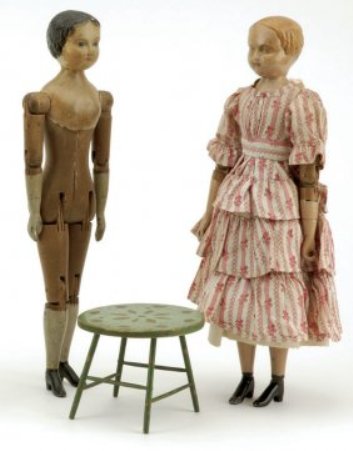
Ellis dolls, with heads of steamed and pressure molded maple and bodies of turned maple, used a patented joint system, each joint using a friction fit split mortise and tenon.

Identification of dolls can be difficult, hindered by the fact many are unmarked, some manufacturers made parts for other doll makers and the market has generated a lot of reproductions. What can help though is learning some characteristics that are almost unique to certain makers, such as in the case of the dolls created by the Co-operative Manufacturing Company of Springfield, Vt.

The company was founded by Joel Addison Hartley Ellis (1858-1925) in the early 1870s. Ellis’ operation started out in1856 as a woodworking shop for the manufacture of doll carriages, baby carriages, sleds, carts and wagons.

Ellis dolls, which were made circa 1871-1873, had features that are almost unique: the heads, unlike most of the period are not china or wax, but end grain maple, steamed and pressure molded; the feet and hands were cast metal; even the bodies differed most Victorian dolls, in that they were turned maple and not stuffed kid or composition.

Another feature that differed from most Victorian dolls is that the Ellis dolls used a patented joint system, each joint using a friction fit split mortise and tenon. This system allowed the doll to be posed in any number of positions.

Ellis dolls came in 12-, 15- and 18-inch sizes, but based on surviving examples, the 12″ size must have been the biggest seller. The Ellis dolls are very collectible and, if in good condition, rarely sell at auction for less than $300.

What is My Antique Worth? Simplifying Appraisal Values

by Liz Holderman (09/14/10).

Did you know that a single item can have several different appraised values? In fact, when you “Ask a Worthologist” to value an antique or collectible, you will receive three separate values, in addition to some interesting history, background and facts about the item. Why three values? Because professional appraisal guidelines state that appraised values are always dependent on the reason for the appraisal.

To help understand the difference in values, we’ll take a first edition of “The Wonderful Wizard of Oz,” for an example. That book was written in 1899 by L. Frank Baum, illustrated by W. W. Denslow and published in 1900 by George M. Hill. Approximately 35,000 copies were produced, with some variations (or states) based on corrections and changes made during the print run. For our example, we’ll assume that the book is in very good condition, has not been restored and is a second state.

Let’s say you want an appraisal of the book for insurance purposes in case your house burns down or the book is stolen. In that case, the appraiser must determine what it would cost for you to replace the book (in a similar condition and state). The appraiser will have to search bookseller catalogs, advertising lists and antiquarian bookstores to see who has the title for sale and what they are asking for it. The result is called “Replacement Cost” and would probably range between $5,000 and $10,000.

The first edition of L. Frank Baum's "The Wonderful Wizard of Oz" in very good condition. An unrestored second state can be valued three different ways, ranging from $10,000 to $1,000. This is common for all appraised items.

Alternatively, let’s say you want an appraisal for that book because a) you are going to donate it to a charity and want to deduct the donation on your taxes, or b) you have inherited it from a relative and you have to pay estate tax on the value.

The Internal Revenue Service requires that this appraisal be based on “Fair Market Value.” That means that the appraiser must research past comparable sales for the book and determine what it actually sold for in a fair and open market (where both the buyer and seller were fully knowledgeable about the book and could transact at their discretion). Current market trends, buyer’s premiums, shipping costs, selling locations, dates of sale and other factors all come into play. “Fair Market Value” is also used for appraisals when an equitable division of assets is required (such as in a divorce case). In WorthPoint terminology, this is called “Auction Value” and would probably range from $3,000 to $5,000.

Now, let’s say you just want to know the value of the book, for no other reason than your own information—maybe you are thinking about selling it. Guidelines state that somewhat less research is required. If you took this book to a volume used book dealer, he would not pay you “Fair Market Value” for the book because he needs to be able to (hopefully) resell it, cover his expenses and still make a profit. Instead, he will pay you “Market Value” for the book. This is what you will get if you don’t want to research, list with an auction house, package and ship, advertise, pay seller’s fees, rent space at a retail venue or other such efforts. WorthPoint calls this “Quick Sale” and it would probably be around $1,000.

Believe it or not, there is actually another legitimate appraised value that is even lower, although WorthPoint does not include it in their valuations. If the courts seize your assets due to bankruptcy or other legal action, your book might be sold in a distress sale for pennies on the dollar. In this case, an appraisal might be required to determine liquidation value.

Liz Holderman is a Worthologist who specializes in collectible books.

Dirty Old Furniture Finish: Is It ‘Grunge’ or Is It Patina?


by Fred Taylor (05/26/09).

A few years ago I had an elderly lady walk into my antique furniture restoration shop with an unusual request. In a slightly embarrassed manner she told me that she knew this was a professional shop and this was how I made my living, but just this once would I sell her just a little of the “patina” that real pros use. Believe me, if I had had some extra I would have given it to her.

How many times have you heard an appraiser on TV or an auctioneer in person use the term “patina” in describing an antique piece of anything, be it furniture, jewelry clothing, whatever? But if you were able to stop them in mid-sentence could they, in fact, precisely define the word for you? Probably not. As it turns out, the definition of patina is a lot like the definition of pornography. It’s hard to say what it is but you know it when you see it.

There is even discussion about how the word is pronounced. My ancient “American College Dictionary” by Random House places the emphasis on the first syllable so the word is “PAT-ina.” So does the “Columbia Encyclopedia,” Sixth Edition, 2001. In everyday use however, many people—including me—rightly or wrongly, put the emphasis on the second part of the word so it is “pa-TINA.” It doesn’t matter as along as we all know what it means. Or don’t know what it means, as the case may be.

So what does it mean? To some people, the answer is a simple two words: “old dirt.” But that is too simple and not entirely correct. My antique dictionary defines it as a film or encrustation on the surface of an object indicating great age. That’s a good start, but with furniture I think it involves a great deal more than that. The “Encyclopedia of Furniture,” by Joseph Aronson, defines it as “Color and texture of the surface produced by age and wear. In wood furniture the varnish, shellac or oil has a tendency to deepen yet retains transparency; edges wear smooth and sharp outlines are softened.” Now we are getting somewhere.

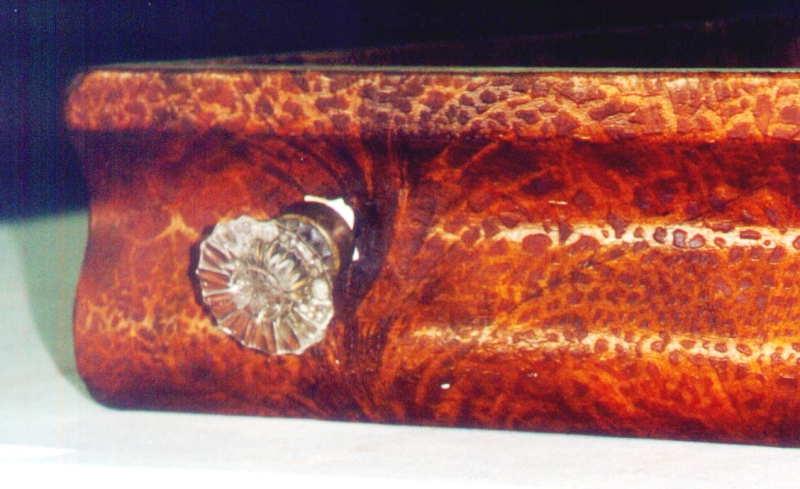
The crackled old shellac finish on this early 19th-century drawer is certainly original and probably qualifies as “patina,” but is it desirable?

The crackled old shellac finish on this early 19th-century drawer is certainly original and probably qualifies as “patina,” but is it desirable?

But that still doesn’t quite cover it. All of those characteristics can be duplicated to some degree by an experienced finisher, so there must be more to it than that. But at least Aronson tried. Many antiques reference books either avoid the subject altogether because it is so hard to handle concisely and accurately, or else they just gloss over it. An example of that treatment can be found in “American Furniture,” by Marvin D. Schwartz, which states that patina is the “Mellow and worn aspect a surface acquires through age; highly desirable quality on most antique furniture.” That steps nicely around it.

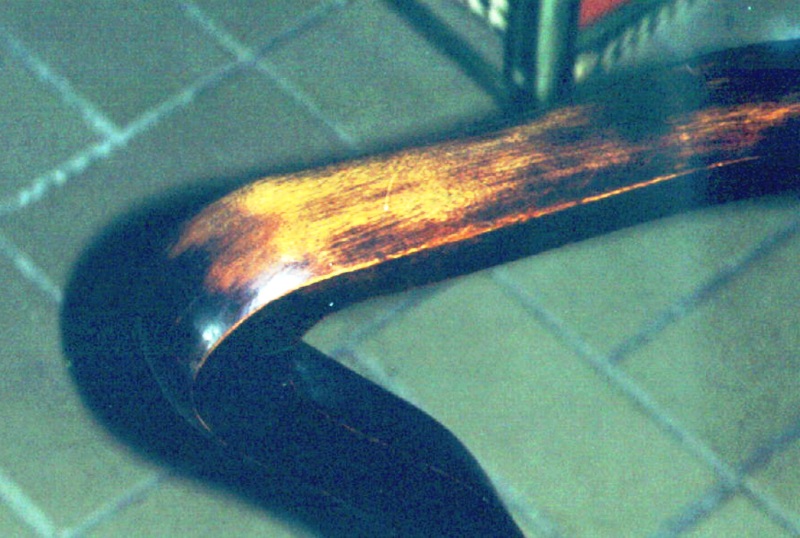
The color on the arm of this birch chair with a mahogany finish is certainly worn. Is this patina? Would you like it on your chair?

The color on the arm of this birch chair with a mahogany finish is certainly worn. Is this patina? Would you like it on your chair?

John Obbard, in his recent book “Early American Furniture” (Collector Books, 2000), gets a little more precise in saying “Patina is the cumulative effect of age, sunlight, wear and grime on old surfaces of wood and metal …” The “Antiques Roadshow Primer,” by Carol Prisant (Workman, 1999), takes a more humanistic approach. It says patina is “the sheen on a surface caused by long handling …” and that it is “… the accumulation of wax, soil, stains and oils that human hands have left on furniture over the course of many years, have created a smooth film of, well, dirt.” There we have the short of it again—dirt, and we humans are to blame; not sunlight, humidity or atmosphere.

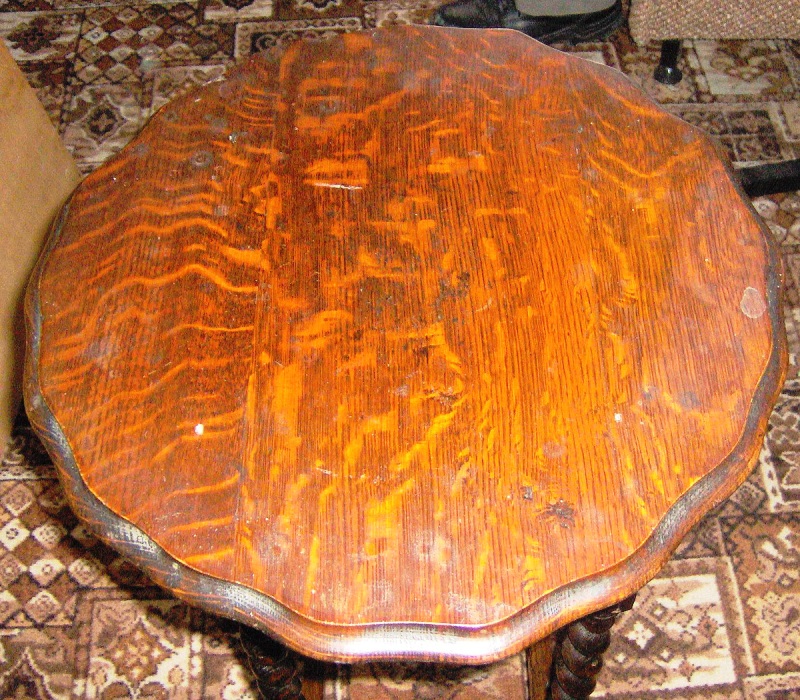
This turn-of-the-century oak table top sure looks-well worn by long handling – and abuse. It still probably qualifies as having patina.

This turn-of-the-century oak table top sure looks-well worn by long handling – and abuse. It still probably qualifies as having patina.

So, by the definitions of the trade, a piece that has patina is dirty, oily, grimy, worn, beat up, faded, rounded and generally disagreeable. By those standards, I have some extremely patinated sneakers. Surely that can’t be the whole thing.

It turns out that patina, whatever it is, has not always been universally desirable. Surely Goddard, Phyfe, Belter and Jellif did not send out their masterpieces all dirty and grimy. They were shiny and clean, new and fresh, and 20 or 30 years ago that was the way much of the antiques trade—including some museum curators—preferred their antiques. And that’s the way many buyers wanted their new old pieces to look. They didn’t want all that dirty old stuff in their new dining room or bedroom, with a crackly old dark finish that could be hiding almost anything, especially the beauty of 200-year-old mahogany. The current emphasis on originality and patina is just that; current. It wasn’t the case 30 years ago and may not be the case 30 years from now.

Perhaps the definition of patina is not as important as we thought it was. Perhaps patina, which, in and of itself, is not always a beautiful thing, judging by the industry definitions, should just be regarded as one more tool of the inquiring collector, used to verify the apparent age of a piece.

Next time you are tempted to discuss the patina of a piece with a dealer or auctioneer, just ask yourself, “Does the piece LOOK, SMELL and FEEL old?” That may be the best definition of all.

Fred Taylor is a Worthologist who specializes in American furniture from the Late Classicism period (1830-1850).

Visit Fred’s website at www.furnituredetective.com. His book “How To Be A Furniture Detective” is now available for $18.95 plus $3 shipping. Send check or money order for $21.95 to Fred Taylor, PO Box 215, Crystal River, FL 34423.

Fred and Gail Taylor’s DVD, “Identification of Older & Antique Furniture,” ($17 + $3 S&H) and a bound compilation of the first 60 columns of “Common Sense Antiques,” by Fred Taylor ($25 + $3 S&H) are also available at the same address.

Thursday, August 5, 2010

Preparing Pets for a Natural Disaster


Natural disasters come in many shapes and sizes. From hurricanes to tsunamis, earthquakes to severe lightning, these ferocious acts of nature can devastate our lives and the lives of our pets.

In 2005, Hurricane Katrina ravaged the nation with one of the costliest and deadliest hurricanes in the history of the United States. In addition to countless people, thousands of pets were left stranded and homeless and many died.

It’s important to learn from the historical path of destruction Katrina left behind. While there is little we can do to prevent a natural disaster, we can, however, protect our pets by preparing for some of them. North Shore Animal League America has created a disaster preparedness kit for animals. It may possibly save your pets’ lives one day.

  • Ensure that all pets have proper identification tags listing their name, owners name, address and phone number **be sure to include a cell phone number**
  • Current rabies tag on collar
  • Current license tag on collar (for canines)
  • Consider microchipping your pet to serve as a back up source of identification should the collar and tags become lost/damage. Be sure to register and activate chip with company
  • Current photographs of all pets (including a close up of their face and one of their full body) with detailed descriptions of special markings and distinguishing features – also consider laminating photos to help protect them from the elements
  • Copies of current veterinary history including medical conditions, vaccination information, prescription medications with dosing and frequency
  • Copies of pre-made LOST PET signs with your animals photo, description and emergency contact information (include your cell phone and phone numbers of other possible contacts) – laminating signs will help protect them from the elements
  • One month supply of your pets current prescription in waterproof containers clearly labeled with name of pet, name of medication and current dosing
  • Monthly dose of heartworm medication and flea/tick medication
  • Extra collars, harnesses, leashes and ID tags
  • A muzzle – in case your pet is injured or frightened and needs to be handled by rescue workers or a veterinarian
  • Containment system to securely and safely transport and temporarily house your pet – this could include a pop-up crate, exercise pen with cover or a standard pet carrier
  • Poop pick up bags or litter box
  • Paper towels
  • Waterless antiseptic hand wash for humans
  • Supply of bottled water
  • Supply of canned and dry food that your pet currently eats – remember that drastic dietary changes can result in gastrointestinal upset for your pet
  • Manual can opener
  • Food and water bowls
  • Phone numbers of local veterinarians, emergency hospitals, boarding kennels, animal shelters and humane societies
  • Emergency contact numbers for alternative caretakers should you yourself become incapacitated or unable to care for you pet
  • Flashlight with fresh batteries
  • Tools – including scissors, tweezers and a thermometer
  • Grooming supplies:
    ~ waterless shampoo
    ~ baby wipes
    ~ brush/comb
  • First aid supplies:
    ~ hydrogen peroxide
    ~ povidone iodine solution (or other antiseptic)
    ~ alcohol
    ~ triple antibiotic ointment for cuts/scrapes
    ~ sterile eye wash
    ~ artificial tears or eye lubricant
    ~ instant ice packs
    ~ gauze squares and cotton balls
    ~ non-adherent dressing (telfa pad or equivalent)
    ~ roll gauze
    ~ conforming bandage (self–adherent)
    ~ adhesive bandaging tape
    ~ latex gloves
  • Waterproof carrying case for supplies - a fishing tackle box is helpful to keep kit organized, clean and dry

Friday, March 12, 2010

CAL FIRE Urges Californians to
Change Your Clocks, Change Your Batteries
Sacramento – With the switch to Daylight saving time this Sunday, March 14, CAL FIRE and the Office of the State Fire Marshal are reminding all California residents to change their smoke alarm batteries when setting their clocks.
Every year, lives are lost due to inoperative smoke alarms. More than 66 percent of home fire deaths that occurred between 2003 and 2006 were in homes without a working smoke alarm, according to the National Fire Protection Association. The changing of the clocks provides an ideal reminder to change your smoke alarm batteries at least twice a year.
“With proper maintenance and regular testing, smoke alarms play a pivotal role in the early notification of a fire emergency,” said Chief Tonya Hoover, acting state fire marshal. “By taking just a few seconds each year to replace the battery, you can truly make a difference in protecting your family and your home.”
CAL FIRE has the following tips on smoke alarms:

Test smoke alarms once a month.

Replace batteries in all smoke alarms twice a year.

Don’t “borrow” or remove batteries from smoke alarms even temporarily.

Regularly vacuum or dust smoke alarms to keep them working properly.

Replace smoke alarms every 10 years.

Don’t paint over smoke alarms.

Practice family fire drills so everyone knows what to do if the smoke alarm goes off. Smoke Alarms Save Lives Fact Sheet
Change Your Clocks & Check Your Smoke Alarm Fact Sheet
Find more information visit the CAL FIRE Web site at www.fire.ca.gov.

Wednesday, February 10, 2010

Where Can I Donate or Recycle My Old Computer and Other Electronic Products?

Find a Local Program Exit EPA

  • Earth 911
    Earth 911 is a comprehensive communication medium for the environment. Earth 911 has taken environmental hotlines, web sites and other information sources nationwide, and consolidated them into one network. Once you contact the Earth 911 network, you will find community-specific information on eCycling and much more.

  • My Green Electronics
    Provided by the Consumer Electronics Association, this site is a resource for consumers wishing to purchase green products and/or searching for local opportunities to recycle or donate used electronics.

  • Electronic Industries Alliance's Consumer Education Initiative
    The Electronic Industries Alliance's eCycling Central Web site helps you find reuse, recycling and donation programs for electronics products in your state.

  • TechSoup
    TechSoup has compiled a comprehensive body of information to promote computer recycling and reuse. This site provides resources for those who would like to donate hardware, those who would like to acquire recycled hardware, and refurbishers.

  • Rechargeable Battery Recycling Corporation (RBRC)
    RBRC can help you recycle portable rechargeable batteries commonly found in cordless power tools, cellular and cordless phones, laptop computers, camcorders, digital cameras, and remote control toys. Search for collection sites by zip code.

Protect metal surfaces on Fire and Water Loss Jobs

Boeshield T-9® was developed and licensed by The Boeing Company to fill their need for a superior lubricant/protectant.

The formulation, based on a unique combination of solvents and waxes, is designed to penetrate metal pores and dissolve minor corrosion, then leave a resilient waxy coating that lasts for many months.

We began by successfully introducing Boeshield T-9® to the tough saltwater marine market for lubricating and protecting all metals. It works well on engines and deck hardware as well as electronics, batteries and wiring connections. It is non-conductive and will not cause short circuits.

For bicycle chains, T-9® has proven to be a tough, long lasting waterproof lubricant. Our sales keep growing every year despite many competitors.

On woodworking tool surfaces Boeshield T-9® recently topped all other surface treatments in Wood Magazine's article on Rust Busters*. According to them: “Except for the section treated with Boeshield T-9® all sections have completely rusted over”. “There is only one choice for protectant as far as we’re concerned: Boeshield T-9®”.

We feel we have the best product of its type on the market. In fact, if you think you’ve found a better penetrating lubricant and protectant, let us know, and we will refund your purchase price.


* Penetrates deeply into fasteners and fixtures.
* Displaces moisture.
* Dries to a clean waxy film.
* Lubricates and protects all metals for months.
* Will not harm paints, plastics, rubber or vinyl.
* Attacks existing corrosion.
* T-9® will also loosen rusted parts.
* Contains No Fluorocarbons
* Many Industrial and Household uses.

® Trademark and Technology owned and licensed by
THE BOEING COMPANY

Thursday, January 28, 2010

10 Worst Germ Hot Spots
Locations that may surprise you—and how to make a clean sweep

By Alyssa Shaffer
Win the War on Germs
1. Kitchen Faucet
2. Garbage Disposal
3. Welcome Mat
4. Vacuum Cleaner
5. Dish Towel
6. Car Dashboard
7. Soap Dispensers
8. Restaurant Ketchup Bottle
9. Refrigerator Seal
10. Cell Phone
Win the War on GermsYou may scrub your toilet and countertops until they shine, but these scary new bacteria breeding grounds require just as much attention.
Germs (the catchall name for bacteria, viruses, and other microorganisms) are everywhere--at home, in the office, even in your car. Luckily, about 99% of them can't harm us. But the other 1% can be annoying, uncomfortable, or downright scary: Most of these pathogens are either viral or bacterial and can cause everything from a runny nose to a potentially life-threatening infection. You may think you know the obvious places that germs propagate--the doctor's office, the soles of your shoes--but many more germ-friendly locales are completely unexpected yet no less dangerous. We uncovered a host of surprising new spots where germs like to lurk, and offer easy solutions to keep you and your family safe and healthy. Click here for the whole story: http://www.prevention.com/10worstgermspots/

Saturday, January 23, 2010

OSHA eTools and Electronic Products for Compliance Assistance

OSHA eTools and
Electronic Products for Compliance Assistance


OSHA recognizes the utility of distributing information through the Internet and CD-ROMs.
The following electronic products for compliance assistance are available:

eTools, Expert Advisors, eMatrix

eTools are "stand-alone," interactive, Web-based training tools on occupational safety and health topics.
They are highly illustrated and utilize graphical menus.
Some also use expert system modules, which enable the user to answer questions,
and receive reliable advice on how OSHA regulations apply to their work site.

Expert Advisors are based solely on expert systems.

Selected eTools are available as downloadable files for off-line use.

eTools Ergonomics eTools eTools en Español Expert Advisors eMatrix


www.osha.gov www.dol.gov

Monday, January 18, 2010

Track It Back - Recover Lost Electronics

Special Report:

See TrackItBack in action on the streets of Chicago

Two cell phones, purposely lost in downtown Chicago. Using hidden video cameras, watch as a third party records what happens next. Will the phones be found and returned? See for yourself!

http://www.trackitback.com/us/testimonials.html


Saturday, January 16, 2010

Sesame Street Fire Safety Station Curriculum

Sesame Street Fire Safety Station Activity Book

This activity book and the accompanying audiocassette of songs and stories helps educators reach preschoolers with simple, memorable fire safety messages. Both have been created with the resources and expert guidance of the USFA and Sesame Workshop™.

The original Sesame Street Fire Safety Station project began in 1979 and has been well-recognized for its effectiveness in reaching and teaching preschoolers. We’ve updated and examined upon this information to bring you Sesame Street Fire Safety Station. Whether you’re a teacher, child care provider, fire safety educator, firefighter, nurse, or burn center administrator, these materials will support your preschool fire safety education efforts. Use them to form the core of your program or to supplement what you’re already doing in this regard. The book and audio cassette have both been designed to be effective in one-time teaching situations or on an ongoing basis. We hope Sesame Street Fire Safety Station will make preschool fire safety education easier for you and more fun for everyone.

Order Information

The kit is only available to preschools, fire departments and individuals who home school or teach young children. Requests from schools, fire departments and other organizations must be faxed on organization letterhead to (301) 447-1213. Home school requests may be made by calling (301) 447-1189. USFA reserves the right to limit order quantities.

Free Fire Safety Info For Kids - FREE DOWNLOADS


http://www.firesafety.gov/kids/flash.shtm

http://www.usfa.dhs.gov/downloads/pdf/publications/fa-176.pdf

http://www.usfa.dhs.gov/downloads/pdf/publications/fa-295-press.pdf

http://www.fema.gov/kids/tsunami/

Monday, January 4, 2010

Water rings
Do your wood end tables or coffee tables have rings from water glasses being set down? Using one cup of vinegar with one cup of olive oil rub with the grain on your wood furniture you can make the stain disappear.